Driving the Future of Public Transport
🔋 EV Battery Technologies: One Solution Does Not Fit All
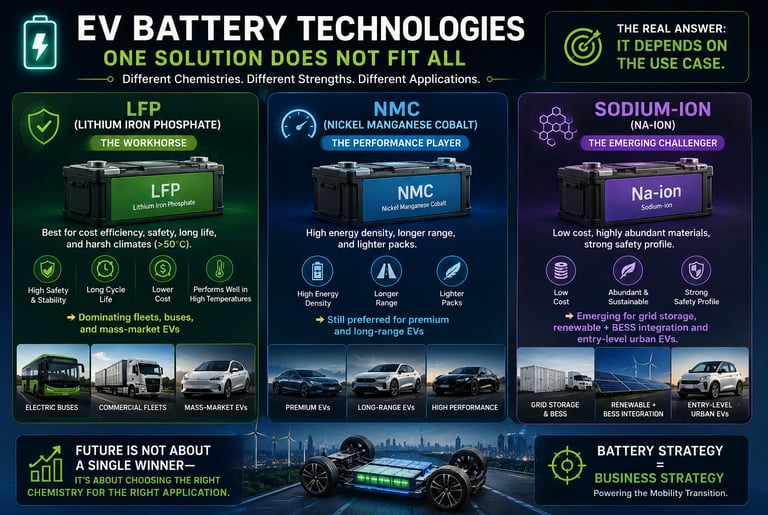
The EV battery landscape is no longer a one-technology-fits-all market. Most people still ask: “Which is the best EV battery?” But the real answer is: It depends on the application. Different battery chemistries are optimized for different priorities such as: cost, safety, energy density, charging speed, lifecycle, and operating environment. Here’s how the EV battery landscape is evolving today: 🔹 LFP (Lithium Iron Phosphate) — The Workhorse LFP batteries continue gaining global market share due to their: strong thermal stability, long cycle life, lower cost, and improved safety performance. They are particularly well suited for: commercial fleets, electric buses, energy storage systems, and high-temperature operating environments (>50°C). Key Advantages: Lower fire risk Longer operational lifespan Reduced maintenance concerns Lower dependency on cobalt and nickel 👉 LFP is increasingly dominating: fleet applications, public transport, and mass-market EV platforms. 🔹 NMC (Nickel Manganese Cobalt) — The Performance Player NMC batteries remain important where: higher energy density, longer driving range, and lighter battery packs are critical requirements. They continue to be preferred for: premium EVs, high-performance vehicles, and long-range passenger applications. Key Advantages: Higher energy density Better range-to-weight ratio Strong performance characteristics 👉 NMC still leads in: premium EV segments, performance-oriented platforms, and long-distance applications. 🔹 Sodium-Ion (Na-ion) — The Emerging Challenger Sodium-ion batteries are now emerging as a promising next-generation alternative. Although still in early commercialization stages, they offer: lower material costs, highly abundant raw materials, strong safety characteristics, and reduced reliance on critical minerals. Expected Applications: grid-scale energy storage, renewable + BESS integration, entry-level urban EVs, and low-cost mobility solutions. 👉 Sodium-ion technology could play a major role in: affordable electrification, energy storage expansion, and developing-market mobility. ⚡ Battery Strategy = Business Strategy The future of EVs will not be defined by a single battery winner. Instead, success will depend on selecting: the right chemistry, for the right application, under the right operational conditions. We are entering an era where: battery strategy is becoming business strategy.
3/12/20261 min read
Connect
Get in touch for sustainable transport solutions.
Head of Operations (Australia): Mr. Tauqeer Banoori
© 2025. All rights reserved.