⚡ Fleet Electrification & Cost Reduction Solutions
AI-Powered Predictive Maintenance for Commercial EV Fleets: The Future of Fleet Reliability
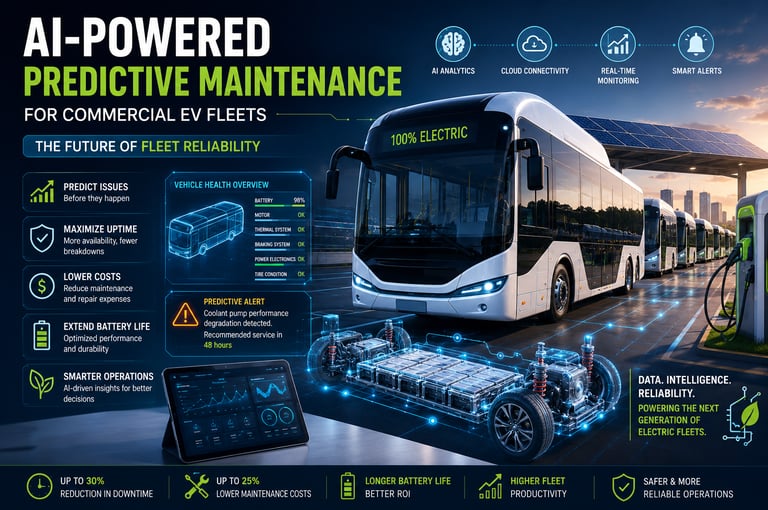
As commercial electric vehicle fleets continue expanding worldwide, fleet operators are increasingly focusing on one critical objective: "Maximizing Vehicle Availability While Minimizing Downtime" Unlike conventional maintenance strategies that rely on fixed service intervals or reactive repairs, modern fleet operators are beginning to embrace a more intelligent approach: AI-Powered Predictive Maintenance; By combining artificial intelligence, vehicle telematics, battery diagnostics, and real-time data analytics, predictive maintenance enables fleet managers to identify potential failures before they occur. The result is: Reduced downtime, Lower maintenance costs, Improved vehicle reliability, Enhanced battery lifespan and Better fleet utilization. As commercial EV adoption accelerates, AI-powered predictive maintenance is expected to become one of the most important technologies shaping the future of fleet operations. What Is Predictive Maintenance? Traditional maintenance generally follows one of two approaches: Reactive Maintenance or Repairing components after failure occurs. Preventive Maintenance; Performing maintenance at scheduled intervals regardless of actual component condition. "Predictive maintenance introduces a third approach: Condition-Based Maintenance, Using real-time vehicle data and artificial intelligence to predict when maintenance will be required before a failure occurs. Instead of asking: "When should this component be serviced?" Predictive maintenance asks: "What is the actual condition of this component right now?" This allows maintenance activities to be performed precisely when needed. "Why Predictive Maintenance Is Important for EV Fleets- Commercial EV fleets depend heavily on: Battery systems, Power electronics, Electric motors, Thermal management systems and Communication networks. Many of these components generate large amounts of operational data every second. Artificial intelligence can analyze this data to identify: Abnormal behavior, Performance degradation, Early warning signs and Failure trends, before they become serious operational problems. 1. Battery Health Monitoring- The battery pack is typically the most valuable component in an electric vehicle. Modern EVs continuously monitor: Cell voltages, Cell temperatures, State of Charge (SOC), State of Health (SOH) and Charging behavior. AI algorithms can analyze these parameters to detect: Cell imbalance, Abnormal temperature rise, Capacity degradation and Charging anomalies. This enables maintenance teams to intervene before significant battery damage occurs. For commercial fleets, early battery fault detection can potentially save thousands of dollars in replacement costs. 2. Predicting Battery Thermal Events- Battery overheating remains one of the most important concerns in EV operations. AI systems can continuously monitor: Battery temperatures, Cooling system performance, Ambient conditions and Charging patterns, by analyzing historical trends and real-time data, AI can identify unusual thermal behavior long before critical temperatures are reached. This helps operators: Prevent overheating events, Improve battery safety, Extend battery lifespan and Reduce operational risks. 3. Electric Motor Condition Monitoring- Although electric motors contain fewer moving parts than internal combustion engines, they still require monitoring. AI-driven systems can analyze: Vibration patterns, Temperature trends, Current consumption and Motor efficiency. "Changes in these parameters may indicate: Bearing wear, Alignment issues, Mechanical imbalance and Electrical abnormalities, early detection allows repairs to be planned before operational failures occur. 4. Predictive Monitoring of Power Electronics- Commercial EVs rely heavily on: Inverters, Controllers, DC-DC converters and Power modules, these components operate under significant electrical and thermal stress. AI systems can identify subtle performance changes that may indicate: Component degradation, Cooling issues, Voltage irregularities and Communication faults, this helps prevent unexpected vehicle breakdowns. 5. Battery Thermal Management System (BTMS) Optimization- One of the most critical systems in commercial EV operations is: The Battery Thermal Management System (BTMS), The BTMS regulates battery temperatures during: Charging, Discharging, High-load operation and Extreme weather conditions, AI-powered monitoring can continuously evaluate: Coolant temperatures, Pump performance, Fan operation and Heat exchanger efficiency, This allows operators to identify BTMS issues before they impact battery performance or safety. 6. Reducing Unplanned Downtime- Unexpected vehicle failures can create significant operational challenges for fleet operators. Downtime may result in: Route disruptions, Reduced fleet availability, Increased operational costs and Customer dissatisfaction. Predictive maintenance helps convert: Unplanned Maintenance into Planned Maintenance, allowing repairs to be scheduled during convenient maintenance windows. This improves overall fleet reliability and productivity. 7. Fleet-Wide Data Intelligence- One of AI's greatest advantages is its ability to learn from entire fleets. Instead of analyzing individual vehicles separately, AI platforms can compare data across: Hundreds of vehicles, Thousands of charging cycles and Multiple operating environments, This allows the system to identify patterns that may not be visible through traditional maintenance practices. Fleet-wide intelligence improves: Failure prediction accuracy, Maintenance planning and Asset utilization. 8-Supporting Driver Performance Analysis- Predictive maintenance systems can also evaluate how driving behavior affects vehicle condition. AI can identify: Harsh acceleration, Aggressive braking, Excessive energy consumption and Abnormal vehicle usage. This information can support: Driver coaching programs, Energy optimization initiatives, Battery life improvement strategies and as a result, maintenance and operational efficiency become closely connected. "The Role of Telematics in Predictive Maintenance- Modern EV fleets increasingly utilize: Connected Telematics Platforms, These systems collect data from: Batteries, Motors, Controllers, Charging systems and Environmental sensors. The combination of telematics and AI creates a powerful ecosystem capable of: Real-time diagnostics, Remote monitoring, Automated alerts and Predictive analytics, Fleet managers gain unprecedented visibility into vehicle health and performance. "Challenges of AI-Powered Predictive Maintenance- While the technology offers significant advantages but several challenges remain. These include: Data quality requirements, Cybersecurity concerns, Integration complexity, Skilled workforce requirements and Initial implementation costs, Successful deployment requires both technological capability and organizational readiness. "The Future of Intelligent Fleet Maintenance- As artificial intelligence continues evolving, future maintenance systems may become even more advanced. Future capabilities may include: Self-diagnosing vehicles, Automated maintenance scheduling, AI-assisted repair recommendations, Digital twins of fleet assets and Autonomous fleet health management. The maintenance workshop of the future may rely as heavily on data scientists as traditional technicians. "Why Predictive Maintenance Matters for Fleet Electrification- As fleets become increasingly electrified, maintenance strategies must evolve alongside vehicle technology. Predictive maintenance helps operators: Improve reliability, Extend battery life, Reduce downtime, Lower operating costs and Maximize fleet ROI. For many organizations, AI may become one of the most valuable tools supporting successful fleet electrification. "Final Thoughts- Artificial intelligence is transforming the way commercial EV fleets are maintained. By continuously analyzing vehicle health, operating conditions, and performance trends, AI-powered predictive maintenance enables fleet operators to identify issues before they become costly failures. The benefits include: Increased vehicle availability, Reduced maintenance costs, Improved safety, Better battery health and Higher operational efficiency, as commercial electric mobility continues to grow, predictive maintenance will likely become a standard component of modern fleet management. The future of fleet maintenance is no longer based solely on repairing vehicles, rather it is increasingly about predicting, preventing, and optimizing before problems occur. Thanks
Connect
Get in touch for sustainable transport solutions.
Head of Operations (Australia): Mr. Tauqeer Banoori
© 2025. All rights reserved.
Contact: +61 415 605 202