⚡ Fleet Electrification & Cost Reduction Solutions
Can Driver Training Reduce Energy Consumption in Electric Vehicle Fleets?
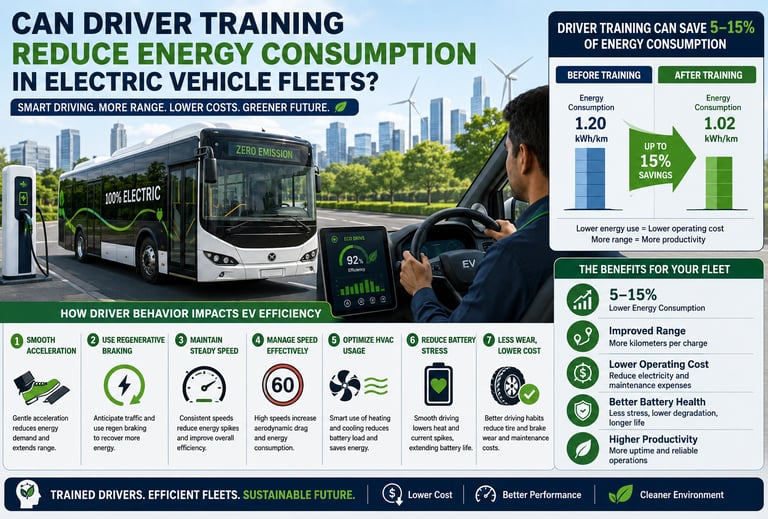
"Commercial fleet operators increasingly transition toward electric mobility, much of the discussion focuses on: Battery technology, Charging infrastructure, Vehicle range and Fleet electrification strategies. However, one critical factor is often overlooked: The Driver Behind the Wheel, In conventional diesel fleets, driver behavior has long been recognized as a major factor influencing fuel consumption. Eco-driving programs routinely help operators reduce: Fuel costs, Vehicle wear and Maintenance expenses. But does the same principle apply to electric vehicles ? The answer is: Absolutely. While EVs are generally more energy-efficient than internal combustion engine (ICE) vehicles, driver behavior still has a significant impact on: Energy consumption, Driving range, Battery health, Tire wear and Fleet operating costs. In many commercial operations, driver training can become one of the simplest and most cost-effective ways to improve fleet efficiency. Why Driver Behavior Matters in EVs, A common misconception is that electric vehicles automatically optimize energy consumption regardless of driving style. While modern EVs use sophisticated software and energy management systems, they still obey the basic laws of physics. The energy required to move a vehicle is closely related to: Vehicle speed, Acceleration, Vehicle mass, Road conditions and Driving behavior. Aggressive driving patterns increase energy demand and reduce efficiency, regardless of whether the vehicle is powered by electricity or diesel. 1. Smooth Acceleration Improves Energy Efficiency. Electric motors deliver: Instant Torque, Unlike diesel engines, EVs can produce maximum torque almost immediately. While this improves vehicle responsiveness, it can also encourage aggressive acceleration, but rapid acceleration causes: Higher battery discharge rates, Increased energy consumption, Greater battery heating and Reduced driving range. Drivers trained to accelerate smoothly can significantly reduce energy usage while maintaining operational performance. For commercial fleets operating hundreds of kilometers daily, these savings accumulate quickly. 2. Regenerative Braking Requires Driver Training:- One of the biggest differences between EVs and conventional vehicles is: Regenerative Braking Feature, During deceleration, the electric motor acts as a generator and recovers kinetic energy. This recovered energy is returned to the battery. The relationship can be simplified as: Kinetic Energy→Electrical Energy. However, energy recovery depends heavily on driver behavior. Drivers who: Anticipate traffic conditions, Avoid sudden braking and Utilize regenerative braking effectively. can recover significantly more energy than drivers relying on conventional braking habits. Proper training helps maximize this efficiency advantage. 3. Maintaining Steady Speeds Reduces Energy Consumption:- Frequent speed fluctuations increase energy demand. Commercial EVs operating in: Urban transport, Logistics operations and Public transportation. often experience stop-and-go conditions. Drivers who maintain: Consistent speeds, Smooth throttle control and Predictable driving patterns can typically achieve better energy efficiency. This is especially important for: Electric buses, Delivery fleets, Airport shuttles and Municipal vehicles, where daily energy consumption directly affects operating costs. 4. High-Speed Driving Reduces EV Efficiency:- Aerodynamic drag increases rapidly with vehicle speed. The drag force relationship can be represented as: Fd∝v2, This means: Small increases in speed can lead to disproportionately larger energy consumption. Driver training programs that encourage: Speed management, Route optimization and Efficient cruising speeds. can significantly improve overall fleet efficiency. 5. HVAC Usage Impacts Energy Consumption:- In many regions, including: Pakistan, Middle East, Africa and Southeast Asia, air conditioning systems operate continuously for much of the year. Unlike diesel vehicles, EV cabin cooling systems draw power directly from the battery. Excessive HVAC usage can reduce: Driving range, Energy efficiency and Operational flexibility. Driver awareness can help optimize: Cabin temperature settings, Cooling practices and Energy consumption, without compromising passenger comfort. 6. Driver Behavior Influences Battery Health:- Battery performance is strongly affected by: Operating temperature, Charge-discharge rates and Current demand. Aggressive driving creates: Higher current spikes, Increased battery heating and Greater thermal stress. Over time, this may contribute to faster battery degradation. Well-trained drivers can help reduce unnecessary battery stress and improve long-term battery life. For fleet operators, extending battery life by even a small percentage can generate substantial financial benefits. 7. Tire Wear and Maintenance Savings:- Driver behavior also affects: Tire life, Brake wear and Suspension components. Aggressive acceleration and braking can increase: Tire replacement frequency, Maintenance costs and Vehicle downtime. Efficient driving techniques help improve overall fleet reliability while reducing operating expenses. "How Much Energy Can Driver Training Save? Actual results vary depending on: Vehicle type, Route characteristics, Climate conditions and Driver experience. However, many fleet operators report energy consumption improvements of approximately: 5–15% ,after implementing structured driver training programs. For a large commercial fleet, this can translate into: Thousands of dollars in annual savings, Increased vehicle range, Reduced charging requirements and Improved operational efficiency. Why Driver Training Becomes More Important in EV Fleets:- As fleets electrify, operating costs shift away from fuel and toward: Electricity consumption, Battery management and Energy optimization. This makes efficient driving even more valuable. Unlike diesel vehicles, where fuel losses may be difficult to track precisely, modern EVs provide detailed data on: Energy usage, Driving behavior, Regenerative braking performance and Efficiency metrics. Fleet managers can therefore monitor driver performance more accurately than ever before. "Fleet Telematics and Driver Coaching:- Modern EV fleets increasingly use: Telematics Systems, These systems can monitor: Energy consumption, Harsh acceleration, Braking behavior, Idle time and Route efficiency. This data enables targeted coaching programs designed to improve efficiency and reduce operating costs. Future AI-powered fleet management platforms may provide real-time driver recommendations to further optimize performance. "Driver Training Is One of the Lowest-Cost Efficiency Improvements: Unlike: New batteries, Additional charging infrastructure and Vehicle upgrades, driver training requires relatively low investment. Yet it can generate immediate benefits through: Reduced energy consumption, Improved range, Lower maintenance costs, Better battery health and Increased operational efficiency. For many fleet operators, it represents one of the fastest-return investments available. "Final Thoughts" The transition to electric mobility is changing the way fleets operate, but one thing remains unchanged: Driver behavior still matters. While EVs are highly efficient vehicles, their performance and operating costs remain strongly influenced by how they are driven. Proper driver training can help: Reduce energy consumption, Improve regenerative braking effectiveness, Extend battery life, Lower maintenance costs and Increase fleet profitability. As commercial fleet electrification continues to expand globally, driver training programs may become just as important as batteries, charging infrastructure, and vehicle technology itself. The future of efficient fleet operation will not depend solely on smarter vehicles — it will also depend on smarter drivers. Thank you
Connect
Get in touch for sustainable transport solutions.
Head of Operations (Australia): Mr. Tauqeer Banoori
© 2025. All rights reserved.
Contact: +61 415 605 202