⚡ Fleet Electrification & Cost Reduction Solutions
Challenges of EV Adoption in Developing Countries !
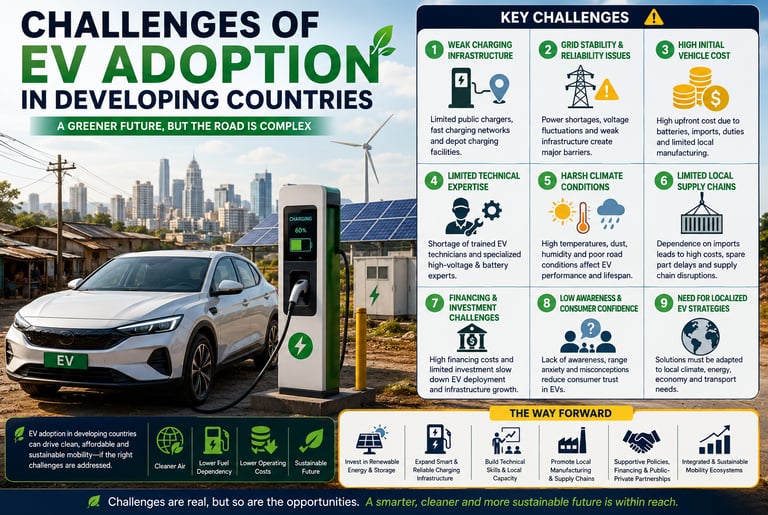
Electric vehicles are rapidly transforming the global transportation industry. Governments and manufacturers worldwide are promoting EV adoption to reduce: Carbon emissions, Fuel dependency, Urban air pollution and Long-term transportation costs. While developed economies are accelerating toward large-scale electrification, many developing countries face a very different reality. For emerging markets, EV adoption involves not only vehicle technology — but also major challenges related to: Infrastructure, Energy systems, Economics, Climate conditions, Technical expertise and Industrial readiness. Despite these challenges, developing countries also represent some of the largest long-term growth opportunities for electric mobility. The future success of EV adoption in these regions will depend heavily on how effectively these barriers are addressed. "Why Developing Countries Matter in the EV Transition" Many developing nations face: Rapid urbanization, Increasing fuel import costs, Rising public transport demand, Severe urban pollution and Expanding logistics industries. Electric mobility offers potential solutions for: Cleaner transportation, Reduced fuel dependency, Improved energy efficiency and Lower long-term fleet operating costs. However, transitioning from conventional transport systems to electric mobility remains significantly more complex in emerging economies. 1. Weak Charging Infrastructure, One of the biggest obstacles to EV adoption in developing countries is: Limited Charging Infrastructure, Many regions still lack: Public charging stations, Fast charging networks, Reliable depot charging systems and Grid-ready charging infrastructure. Unlike developed countries with expanding charging ecosystems, many emerging markets are still in the early stages of infrastructure development. This creates: Range anxiety, Operational uncertainty Fleet planning challenges and Reduced consumer confidence, For commercial fleets, inadequate charging infrastructure can directly affect: Vehicle availability, Route planning and Operational efficiency. 2. Grid Stability & Electricity Reliability Issues, Many developing countries continue facing: Power shortages, Voltage fluctuations, Load shedding, Weak transmission infrastructure and Unstable electricity supply. Mass EV charging can place additional pressure on already stressed electrical grids. Grid balance can be simplified as: Power generation =Power demand When charging demand exceeds available supply, infrastructure instability may occur. This creates serious concerns for: Fleet operators, Charging network expansion, Public transport electrification and Industrial EV deployment. In many regions, successful EV adoption may depend heavily on: Solar-assisted charging, Battery energy storage systems, Microgrids and Decentralized energy infrastructure. 3. High Initial Vehicle Cost: Although EV operating costs may eventually become lower, the: Initial Purchase Price, remains a major barrier in many developing markets. Electric vehicles often cost more upfront due to: Battery expenses, Import duties, Currency exchange impacts, Limited local manufacturing and Low production scale. For consumers and fleet operators in price-sensitive markets, upfront affordability remains one of the biggest challenges. This is especially important for: Public transport systems, Small logistics operators, Independent fleet owners and Commercial transport businesses. 4. Limited Technical Expertise: EV systems require specialized technical knowledge involving: High-voltage systems,, Battery diagnostics, Thermal management, Power electronics and Software systems. Many developing countries still face shortages of: Trained EV technicians, Battery specialists, Diagnostic engineers and High-voltage safety experts. Without proper technical support infrastructure, fleet operators may struggle with: Maintenance quality, Repair capability, Downtime management and Spare parts handling. Technical workforce development is becoming a critical requirement for successful EV expansion. 5. Harsh Climate Conditions: Many developing regions experience extreme environmental conditions including: High ambient temperatures, Dust exposure, Heavy rainfall, Flooding, Humidity and Poor road conditions. These conditions may accelerate stress on: Battery systems, Electronics, Cooling systems and Charging infrastructure. High temperatures can especially affect: Battery degradation, Electronics reliability and Thermal management performance. Commercial EV fleets operating in: Mining regions, Desert environments and Tropical climates, often require more robust engineering solutions than standard passenger EV applications. 6. Limited Local Manufacturing & Supply Chains: Many emerging markets remain heavily dependent on: Imported EVs, Imported batteries, Foreign spare parts and External technology providers. This creates challenges related to: Currency fluctuations, Spare part availability, Maintenance costs and Supply chain delays. Localization of: Battery assembly, Vehicle manufacturing and Components production. will become increasingly important for reducing costs and improving long-term industry sustainability. 7. Financing & Investment Challenges: Large-scale EV deployment requires significant investment in: Charging infrastructure, Grid upgrades, Fleet procurement, Energy systems and Technical training. Many developing economies face: Limited financing access, High borrowing costs, Economic instability and Competing infrastructure priorities. This can slow EV adoption despite strong long-term benefits. Government policy and international investment support may play a critical role in accelerating electrification. 8. Public Awareness & Consumer Confidence: In many regions, public understanding of EV technology remains limited. Common concerns include: Battery lifespan, Charging availability, Safety fears, Maintenance uncertainty and Resale value concerns. Misinformation can slow adoption even when technology is improving rapidly. Education and real-world operational success stories are essential for building confidence in electric mobility systems. "Commercial Fleets May Lead the Transition First" In many developing countries, commercial fleet electrification may expand faster than private passenger EV adoption. This is because: Fleet operations are centralized, Charging can be depot-managed, Operational savings are measurable and Vehicle utilization is higher. Electric buses, logistics fleets, and industrial transport systems may therefore become the first large-scale EV success stories in emerging markets. Renewable Energy Could Become a Major Advantage, Interestingly, developing countries may also have unique opportunities in: Renewable Energy Integration, Regions with strong solar potential can combine: Solar power generation, Battery storage systems and EV charging infrastructure. to reduce: Fuel imports, Grid dependency and Long-term energy costs. Solar-assisted charging ecosystems may become highly valuable for: Public transport, Rural mobility, Remote industrial operations and Off-grid charging systems. "The Future Requires Localized EV Strategies" One important reality is: EV adoption strategies cannot be identical worldwide. Developing countries require solutions adapted to: Local climates, Energy infrastructure, Economic conditions, Transportation patterns and Industrial capability. Future success will depend on: Climate-adapted engineering, Affordable battery technologies, Smart charging systems, Renewable integration and Workforce development. Localized innovation may become one of the biggest drivers of EV growth in emerging economies. "Final Thoughts:- Electric mobility offers enormous long-term potential for developing countries through: Reduced fuel dependency, Cleaner urban transportation, Lower operating costs and Improved energy sustainability. However, large-scale EV adoption also faces major challenges involving: Infrastructure limitations, Grid stability, Economic affordability, Technical expertise and Environmental conditions. The future success of electrification in developing countries will depend not only on vehicle technology — but also on building stronger energy systems, technical capabilities, localized manufacturing, and sustainable mobility ecosystems. The transition may be challenging, but it also represents one of the biggest industrial and energy transformation opportunities for emerging economies in the coming decades. Thanks
Connect
Get in touch for sustainable transport solutions.
Head of Operations (Australia): Mr. Tauqeer Banoori
© 2025. All rights reserved.
Contact: +61 415 605 202