⚡ Fleet Electrification & Cost Reduction Solutions
Fleet Electrification ROI: When Does an EV Fleet Become Profitable?
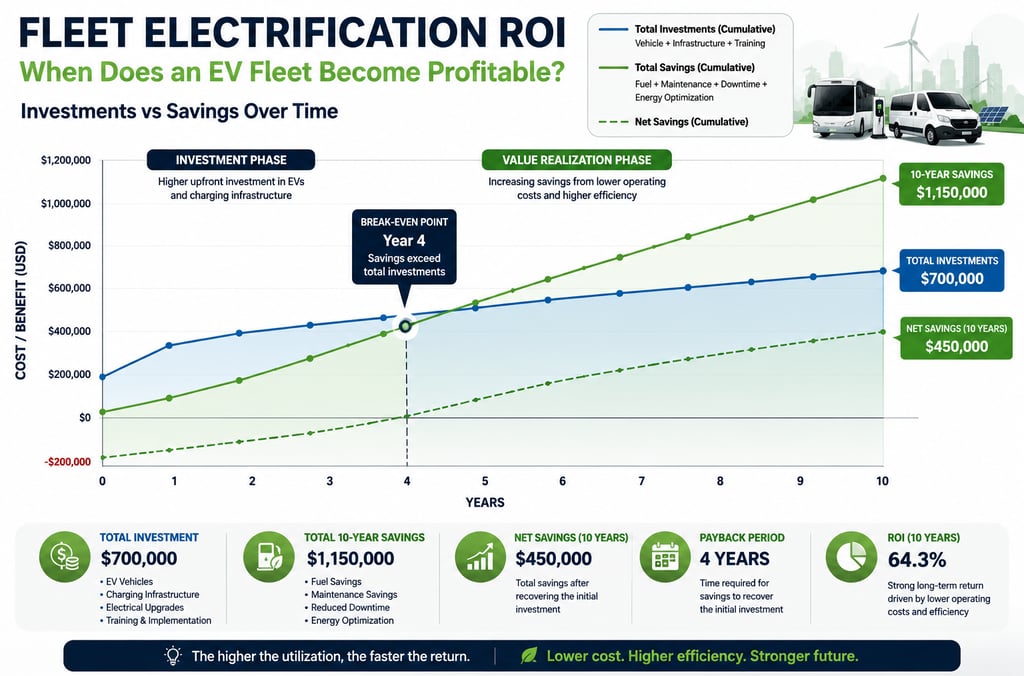
"One of the most important questions facing fleet operators today is: Does fleet electrification actually save money? While electric vehicles offer clear environmental benefits, commercial fleet decisions are ultimately driven by economics. Fleet operators need answers to critical questions such as: How much fuel can be saved? How much will charging cost? What maintenance savings can be expected? How long is the payback period? When does an EV fleet become more profitable than a diesel fleet? The answer depends on several operational factors, but in many commercial applications, fleet electrification is increasingly proving to be a financially attractive long-term investment. The key is understanding the complete: Total Cost of Ownership (TCO) rather than focusing solely on vehicle purchase price. Understanding Fleet Electrification ROI Return on Investment (ROI) measures how quickly an investment generates enough savings to recover its initial cost. A simplified ROI equation can be expressed as: ROI = Total Savings−Additional Investment/Additional Investment×100 For EV fleets, the additional investment typically includes: Vehicle acquisition cost, Charging infrastructure, Electrical upgrades and Training requirements. Savings are generated through: Reduced fuel costs, Lower maintenance expenses, Reduced downtime, Energy optimization and Government incentives (where available). Why Purchase Price Alone Can Be Misleading:- One common mistake is comparing only: EV Purchase Price vs Diesel Vehicle Purchase Price, Electric vehicles often have a higher initial cost because of battery systems. However, over the vehicle lifecycle, fleet economics are influenced by: Fuel consumption, Maintenance costs, Reliability, Energy efficiency and Vehicle utilization rates, For commercial operators, operational costs often exceed the original vehicle purchase cost over time. 1. Fuel Cost Savings- Fuel savings are usually the largest contributor to EV fleet ROI. Consider a commercial vehicle traveling: 100,000 km annually. Typical Diesel Fleet, Assuming: Fuel economy = 3 km/liter. Diesel cost = $1.20/liter. Annual fuel consumption: Fuel Consumption=100000/3=33333 Liters, Annual fuel cost: ≈ $40,000. Typical Electric Fleet; Assuming: Energy consumption = 1.2 kWh/km, Electricity cost = $0.12/kWh, Annual energy usage: Energy Consumption=100000×1.2=120000 kWh Annual charging cost: ≈ $14,400. Annual Energy Savings- Potential annual savings: ≈ $25,000+, per vehicle. Actual savings vary by: Electricity tariffs, Fuel prices, Vehicle efficiency and Operating conditions. However, fuel savings alone often justify electrification in high-mileage applications. 2. Maintenance Cost Reduction- Electric vehicles have significantly fewer moving parts compared to conventional diesel vehicles. EVs eliminate maintenance associated with: Engine oil changes, Fuel injectors, Turbochargers, Exhaust systems, Emission control systems and Transmission servicing. Maintenance focus shifts toward: Battery systems, Thermal management, Electronics and Drivetrain inspections. Commercial operators often report maintenance cost reductions ranging from: 20–50% depending on vehicle type and operating environment. 3. Reduced Downtime Improves Profitability- Vehicle downtime directly affects: Revenue generation Route reliability and Asset utilization. Predictive diagnostics available in modern EVs can help identify: Battery anomalies, Cooling system issues and Electronic faults, before major failures occur. Higher fleet availability often translates into: Improved service reliability, Increased productivity and Better asset utilization. These indirect financial benefits are frequently underestimated. 4. Smart Charging Reduces Operating Costs- Electricity pricing often varies throughout the day. Smart charging strategies can significantly improve ROI by: Charging during off-peak hours, Using renewable energy, Managing charging demand and Avoiding peak tariffs. Fleet operators increasingly deploy: Solar-assisted charging depots, Battery Energy Storage Systems (BESS) and AI-powered energy management. to further reduce charging costs. 5. Battery Life Is Critical to ROI- Battery lifespan remains one of the most important factors influencing profitability. Modern commercial EV batteries often achieve: 3,000~8,000 charge cycles Several hundred thousand kilometers of operation. Battery longevity depends on: Charging practices, Operating temperatures, Duty cycles and Thermal management quality. Proper battery management can significantly improve return on investment. "Typical Fleet Payback Period" The payback period represents the time required for operational savings to recover the additional electrification investment. A simplified equation: Payback Period=Additional Investment/Annual Savings Many commercial fleet projects currently achieve payback periods of: Urban Bus Fleets 4–7 years, Delivery Fleets 3–6 years, Logistics Fleets 4–8 years. The exact timeline depends heavily on: Vehicle utilization, Energy prices, Maintenance costs and Infrastructure investments. "Why Fleet Utilization Matters:- The higher the annual mileage, the faster electrification becomes profitable. High-utilization applications such as: City buses, Airport shuttles, Delivery fleets and Logistics operations, typically achieve ROI faster because fuel savings accumulate rapidly. Low-mileage vehicles may require longer payback periods. This is why commercial fleets are often among the earliest adopters of electrification. "Hidden Financial Benefits of Electrification- Beyond direct operating savings, EV fleets may also benefit from: Energy Independence, Integration with: Solar power, Battery storage systems and Renewable energy infrastructure, can reduce dependence on external fuel markets. "Improved Environmental Compliance- Many cities and governments are introducing: Emissions regulations, Low-emission zones and Sustainability requirements. EV fleets may avoid future compliance costs. "Enhanced Corporate Sustainability" Electrification can strengthen: ESG performance, Sustainability reporting and Corporate reputation, which increasingly influences investment and procurement decisions. "Challenges That Can Affect ROI: Fleet electrification is not without risks. Potential challenges include: High upfront investment, Charging infrastructure costs, Grid limitations, Battery replacement planning and Technical workforce requirements. Successful projects require careful: Route analysis, Energy planning, Maintenance strategy and Infrastructure design, ROI improves significantly when electrification is implemented strategically rather than simply replacing diesel vehicles one-for-one. "The Future of Fleet Economics" As battery prices continue declining and charging infrastructure expands, EV fleet economics are expected to improve further. Future profitability will likely be supported by: Better battery technology, AI-driven fleet management, Renewable energy integration, Second-life battery applications and Smart charging ecosystems. The gap between conventional and electric fleet operating costs is expected to widen over the coming decade. "Final Thoughts" Fleet electrification is no longer only an environmental decision. It is increasingly becoming a financial decision. While electric fleets often require higher upfront investment, the combination of: Fuel savings, Reduced maintenance costs, Lower downtime, Smart charging optimization and Renewable energy integration can generate substantial long-term economic benefits. For many commercial operators, the question is no longer: "Can EV fleets become profitable?" but rather: "How quickly can they become profitable?" As technology continues advancing and operating experience grows, fleet electrification is increasingly proving to be both a sustainable and economically viable strategy for the future of transportation.
Connect
Get in touch for sustainable transport solutions.
Head of Operations (Australia): Mr. Tauqeer Banoori
© 2025. All rights reserved.
Contact: +61 415 605 202