⚡ Fleet Electrification & Cost Reduction Solutions
Grid Stability Challenges with Mass EV Adoption !
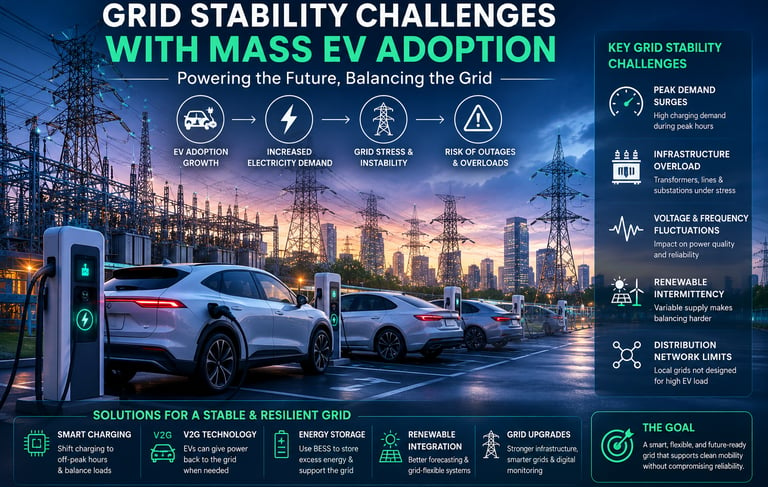
The global transition toward electric mobility is accelerating rapidly. Governments, automakers, and energy companies worldwide are investing heavily in: Electric vehicles, Charging infrastructure, Renewable energy systems and Smart energy technologies. As EV adoption expands, transportation systems are becoming increasingly electrified at an unprecedented scale. However, alongside the benefits of electrification comes an important question: Can existing power grids handle mass EV adoption? While electric vehicles help reduce: Fuel dependency, Urban emissions, Noise pollution and Carbon intensity. Large scale charging demand may also create significant pressure on electrical infrastructure. The future success of electric mobility will depend not only on better vehicles but also on how effectively energy grids can support millions of EVs simultaneously. "Why Grid Stability Matters" Electrical grids are designed to balance: Electricity Supply and Demand, in real time. This balance can be simplified as: Power generation = Power demand If electricity demand suddenly exceeds available generation or transmission capacity, grids may experience: Voltage instability, Frequency fluctuations, Transformer overloads, Localized blackouts and Infrastructure stress. Mass EV charging introduces a new category of high-power electrical demand that grids must learn to manage efficiently. "EV Charging Significantly Increases Electricity Demand" Individual EV charging may appear manageable on its own. However, large scale adoption creates a cumulative effect. For example: Residential EV charging, Commercial fleet charging, Public fast charging, Bus depot charging and Logistics fleet electrification can collectively create massive simultaneous electricity demand. High-power DC fast charging systems may require: Hundreds of kilowatts, Megawatt-scale charging capacity, Continuous high-load operation, As commercial transport electrifies, charging demand may increasingly resemble industrial-scale power consumption. Peak Demand Is One of the Biggest Challenges" One major concern is: Peak Load Demand, If large numbers of EVs begin charging simultaneously during: Evening hours, Hot weather conditions, High commercial activity periods, then electricity demand may rise sharply. This can overload: Distribution transformers, Local substations, Transmission networks and Urban electrical infrastructure, Peak demand spikes are especially problematic because electrical infrastructure must be sized for maximum load conditions, even if those peaks occur only briefly. Fast Charging Creates Additional Grid Stress" Ultra-fast charging infrastructure is expanding rapidly. Modern commercial EV charging systems may operate at: Megawatt-level charging capacity, The power demand relationship can be approximated by: P=VI where: P = power V = voltage I = current Higher charging power therefore requires: Larger electrical infrastructure, Higher current handling capability, Improved thermal management and Stronger grid stability controls. Mass deployment of fast charging stations without proper planning may significantly strain local grids. "Commercial Fleet Charging Magnifies the Challenge" Commercial EV fleets create even greater grid pressure because: Multiple vehicles often charge simultaneously, Charging schedules are concentrated, Depot charging may occur overnight, Fleet energy demand is highly predictable but very large, Applications such as: Electric bus depots, Logistics centers, Industrial fleets and Delivery hubs, may require megawatt scale charging infrastructure. Without smart energy management, fleet charging depots can create substantial localized grid stress. "Renewable Energy Integration Adds Complexity" Many countries are simultaneously expanding: Solar energy, Wind power and Renewable electricity generation; While renewable energy supports decarbonization goals, it also introduces: Intermittency Challenges, Solar and wind generation depend heavily on: Weather conditions, Time of day and Seasonal patterns. This creates variability in electricity supply. Managing EV charging alongside variable renewable generation requires highly intelligent energy coordination systems. "Smart Charging Will Become Essential" One of the most important future solutions is: Smart Charging: Smart charging systems can: Delay charging during peak demand, Optimize charging schedules, Balance grid loads, Prioritize renewable energy usage and Reduce infrastructure stress. Instead of charging immediately upon connection, vehicles may charge when: Electricity demand is lower, Renewable energy availability is higher or Grid capacity becomes available, Smart charging transforms EVs from uncontrolled electrical loads into manageable energy assets. "Vehicle-to-Grid (V2G) Technology" Future EVs may not only consume electricity, they may also help stabilize grids. This concept is known as: Vehicle-to-Grid (V2G) In V2G systems: EV batteries temporarily supply energy back to the grid Vehicles act as distributed energy storage systems, Grid operators can stabilize electricity demand dynamically, The simplified energy flow becomes: Grid↔EV Battery, Potential benefits include: Grid stabilization, Renewable energy balancing, Backup power support and Reduced peak demand, Commercial fleets may eventually become mobile energy storage networks. "Battery Energy Storage Systems (BESS) Can Reduce Grid Stress" Large charging depots increasingly use: Battery Energy Storage Systems, These systems: Store electricity during low-demand periods, Buffer high charging demand, Reduce transformer loading and Improve charging stability. Battery storage can also support: Solar-integrated charging depots, Renewable energy optimization and Off-grid charging systems. Second-life EV batteries may play an important role in future charging infrastructure. "Grid Infrastructure Upgrades Will Be Necessary" Mass electrification will require major investment in: Transmission systems, Distribution networks, Transformers, Substations and Smart grid technologies. Many existing electrical grids were originally designed for: Residential loads, Conventional industrial demand and Predictable electricity consumption patterns, EV adoption introduces: Dynamic charging behavior, Distributed high power demand and Mobile energy consumption patterns. Future grids must become: Smarter, More flexible, More decentralized and Digitally optimized. "Artificial Intelligence Will Help Manage Future Grids" AI-driven energy management systems are expected to play a major role in: Demand forecasting, Charging optimization, Renewable energy balancing, Grid stabilization and Predictive infrastructure management. AI may help utilities: Prevent overload conditions, Optimize electricity distribution, Improve infrastructure efficiency and Reduce energy waste. Future grids will increasingly rely on software intelligence as much as physical infrastructure. "Emerging Markets Face Additional Challenges" Developing countries may face unique difficulties with mass EV adoption due to: Weak grid infrastructure, Limited transmission capacity, Power shortages, High energy losses and Unstable electricity supply. In these regions, successful EV adoption may depend heavily on: Solar assisted charging, Battery storage systems, Decentralized energy networks and Microgrids. Localized energy ecosystems may become more practical than relying solely on centralized grid expansion. "The Future Grid Will Be Very Different" The electrical grid of the future will likely evolve into: An Intelligent Energy Network, integrating: EV charging systems, Renewable generation, Battery storage, Smart infrastructure, AI-driven optimization and Distributed energy systems. Electric vehicles may eventually become active participants in the energy ecosystem rather than simply transportation devices. "Final Thoughts" Mass EV adoption represents one of the biggest transformations ever experienced by modern electrical infrastructure. While electric mobility offers enormous environmental and economic advantages, it also introduces major challenges related to: Grid stability, Peak electricity demand, Charging infrastructure, Renewable energy integration and Energy management. The future success of global electrification will depend not only on vehicle innovation, but also on building smarter, stronger, and more resilient energy systems capable of supporting the next generation of transportation. The future of mobility and the future of energy are now becoming deeply interconnected.
Connect
Get in touch for sustainable transport solutions.
Head of Operations (Australia): Mr. Tauqeer Banoori
© 2025. All rights reserved.
Contact: +61 415 605 202