⚡ Fleet Electrification & Cost Reduction Solutions
How EV Conversion Can Reduce Fleet Fuel Costs by Up to 70%
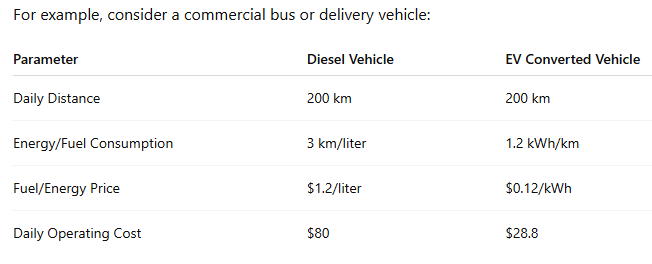
As fuel prices continue to increase globally, placing significant financial pressure on commercial fleet operators, logistics companies, public transport operators, and industrial vehicle owners. In many developing regions including Pakistan, Nigeria, and other African markets, fuel expenses represent one of the largest operational costs for fleet businesses. As a result, many organizations are now exploring Electric Vehicle (EV) conversion solutions as a practical alternative to conventional diesel-powered fleets. EV conversion involves replacing the internal combustion engine and fuel system of an existing vehicle with an electric drivetrain, battery system, and intelligent power electronics. While many fleet operators initially focus on the environmental benefits of electrification, the real game changer is often operational cost reduction. In real world fleet operations, EV conversions can reduce energy and fuel costs by up to 70%, especially for urban duty cycles buses, delivery vehicles, and utility fleets. This article explains how EV conversion delivers these savings, the factors affecting return on investment (ROI), and why fleet operators worldwide are increasingly adopting commercial electrification strategies. "Understanding The Fleet Operating Costs" For conventional diesel fleets, operational expenses usually include: Diesel fuel costs, Engine oil and filters, Transmission maintenance, Cooling system servicing, Exhaust system repairs, Injectors, turbocharger maintenance and Frequent mechanical wear and tear of different parts and assemblies. Commercial vehicles operating in stop and go city traffic often consume large amounts of fuel while idling and accelerating repeatedly. This significantly increases operating costs over time. Electric drivetrains operate differently. Electric motors are highly efficient, produce instant torque, and eliminate many mechanical systems found in conventional vehicles. As a result, EV-converted vehicles typically achieve: Lower energy costs per kilometer, Reduced maintenance requirements, Lower downtime, Improved drivetrain efficiency and Reduced dependency on fuel supply fluctuations. How EV Conversion Reduces Fuel Costs:- 1. Electricity Is Cheaper Than Diesel" The largest savings come from replacing diesel fuel with electricity. In countries where fuel prices are unstable or heavily taxed, the savings become even more substantial. EV Motors Are More Efficient Electric motors are inherently more efficient than internal combustion engines. Typical diesel engine efficiency: ηdiese l≈ 35%−40% Typical electric motor efficiency: ηEV ≈ 85%−95% This means more of the supplied energy is converted into useful vehicle motion rather than being wasted as heat. For fleet operators, higher efficiency directly translates into lower operating expenses. 2-Reduced Maintenance Costs, One of the biggest hidden benefits of EV conversion is reduced mechanical maintenance. Traditional diesel vehicles contain: Engine oil systems, Gearboxes, Clutches, Fuel injection systems, Exhaust systems, Turbochargers, Radiators and cooling assemblies, While electric drivetrains eliminate many of these components entirely. This reduces: Scheduled maintenance frequency, Spare parts consumption, Workshop downtime and Unexpected mechanical failures. For commercial fleets, downtime reduction alone can significantly improve profitability. 3-Regenerative Braking Improves Efficiency: Commercial vehicles operating in urban traffic frequently brake and accelerate. EV systems can recover braking energy using regenerative braking technology. E recovered = 1/2*mv*2 Instead of wasting kinetic energy as heat, the system converts part of it back into stored battery energy. This feature is particularly effective for: City buses, Urban delivery vehicles, Waste collection fleets and Shuttle services. "EV Conversion ROI for Fleet Operators" Return on Investment (ROI) is one of the most important considerations for commercial fleet operators. A simplified ROI formula can be expressed as: ROI=Conversion Cost/Annual Savings Typical factors influencing ROI include: Daily vehicle mileage, Local electricity pricing, Diesel pricing, Battery capacity, Vehicle duty cycle, Maintenance savings and Charging infrastructure costs. High-mileage fleets generally achieve faster ROI because fuel savings accumulate more rapidly. Many commercial fleets can recover EV conversion costs within: 2 to 5 years for buses, 2 to 4 years for delivery fleets, 3 to 6 years for industrial utility vehicles. Additional Benefits Beyond Fuel Savings, Lower Noise Pollution- Electric drivetrains are significantly quieter than diesel engines, improving driver comfort and reducing urban noise pollution. "Energy Independence, Fleet operators can integrate: Solar charging systems, Battery energy storage and Off-grid charging infrastructure. This reduces dependence on unstable fuel supply chains. "Environmental Compliance- Many cities and governments are introducing stricter emissions regulations. EV conversion helps organizations: Reduce carbon emissions, Improve ESG compliance, Meet environmental targets and Enhance corporate sustainability image. "Challenges Fleet Operators Must Consider: Although EV conversion offers major benefits, successful implementation requires proper engineering and technical planning. Key considerations include: Battery system selection, Thermal management, Vehicle weight distribution, Charging infrastructure, Electrical safety systems, Motor controller compatibility and Long term maintenance planning. Commercial EV conversion should always be approached as an engineered mobility solution rather than simply replacing an engine with a motor. "Why Developing Markets Have Huge Potential" Countries in Africa, South Asia, and emerging economies often experience: High diesel prices, Aging fleet infrastructure, Urban pollution challenges and Limited fuel stability. These conditions create strong opportunities for commercial EV conversion projects. Fleet operators can continue using existing vehicles fleet while modernizing them with electric drivetrains, reducing both operational costs and vehicle replacement expenses. Conclusion:- EV conversion is no longer an experimental concept. It is rapidly becoming a financially practical solution for commercial fleets seeking lower operating costs, improved energy efficiency, and reduced maintenance expenses. For high mileage commercial operations, fuel savings alone can dramatically improve fleet economics over the vehicle lifecycle. When combined with lower maintenance costs and energy independence opportunities, EV conversion becomes an increasingly attractive strategy for fleet operators worldwide. As battery technology, charging infrastructure, and power electronics continue to improve, commercial EV conversions are expected to play a major role in the future of sustainable transportation. Need Technical Support for Commercial EV Conversion? Zeroshift Mobility provides technical consultation and support for: Commercial EV conversions, Fleet electrification planning, Battery and motor system selection, EV maintenance strategies, Solar-integrated range extender solutions and Fleet operational cost optimization. Whether you operate buses, logistics fleets, utility vehicles, or industrial transport systems, professional engineering support is critical for a successful electrification project. Thanks
https://www.linkedin.com/in/imtiaz-ahmad-268862230/
Connect
Get in touch for sustainable transport solutions.
Head of Operations (Australia): Mr. Tauqeer Banoori
© 2025. All rights reserved.
Contact: +61 415 605 202