⚡ Fleet Electrification & Cost Reduction Solutions
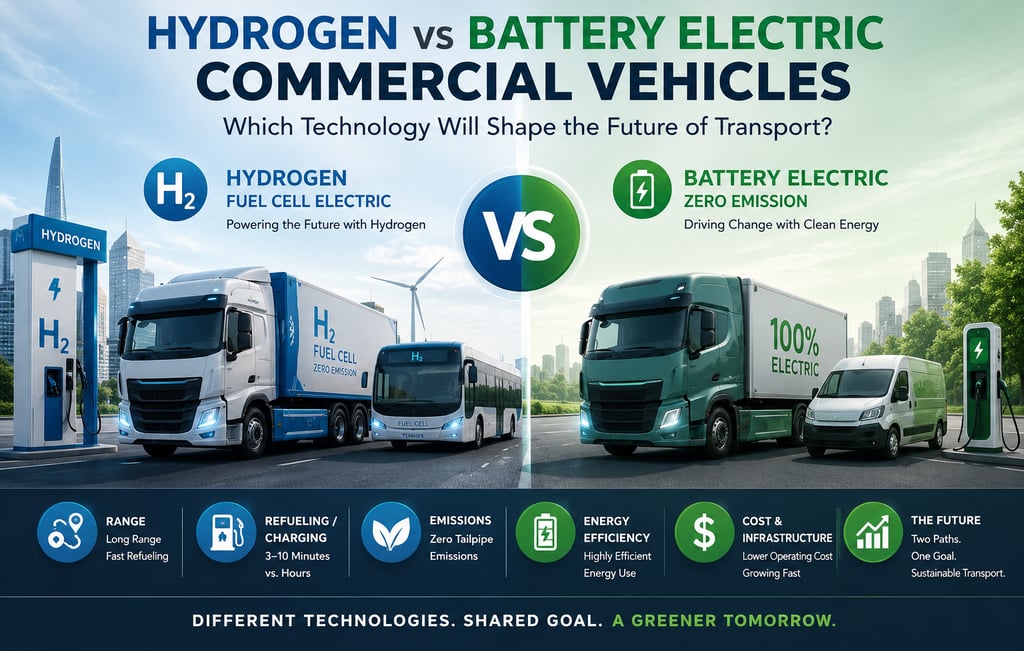
Hydrogen vs Battery Electric Commercial Vehicles: Which Technology Will Shape the Future of Transport ?
"Global commercial transportation industry is undergoing one of the biggest technological transitions in modern history. Governments, fleet operators, and manufacturers worldwide are searching for cleaner alternatives to conventional diesel-powered transport systems in order to reduce: Carbon emissions, Fuel dependency, Urban air pollution and Long-term operating costs. Among the leading zero-emission technologies, two major solutions are receiving global attention: Battery Electric Vehicles (BEVs) & Hydrogen Fuel Cell Electric Vehicles (FCEVs). Both technologies aim to reduce emissions and improve transportation sustainability. However, they operate using very different engineering approaches. The growing debate is no longer whether transportation will electrify but rather: Which technology is better suited for commercial transport applications? The answer depends on multiple factors including: Vehicle duty cycle, Operating environment, Infrastructure availability, Energy efficiency, Payload requirements and Fleet operating economics. Understanding the Difference: Although both technologies use electric motors for propulsion, the source of electrical energy is completely different. "Battery Electric Vehicles (BEVs)" Battery electric commercial vehicles store electrical energy directly inside battery packs. The vehicle is charged using external electricity sources such as: Grid charging, Fast charging stations, Renewable energy systems and Solar assisted charging infrastructure. The stored electrical energy powers: Electric motors, Electronics systems and Thermal management systems. Battery electric vehicles are currently dominating many segments of the EV industry, especially: Urban buses, Delivery fleets, Passenger EVs and City logistics vehicles. Hydrogen Fuel Cell Electric Vehicles (FCEVs)" Hydrogen vehicles also use electric motors, but electricity is generated onboard using: Hydrogen Fuel Cells, Inside the fuel cell system, hydrogen reacts electrochemically with oxygen to produce electricity. The simplified fuel cell reaction can be expressed as: 2H2 + O2 → 2H2O + Energy. The primary byproduct is: Water vapor. Hydrogen fuel cell systems are gaining attention for: Heavy duty transportation, Long distance trucking, Industrial operations and High utilization commercial fleets. 1. Energy Efficiency Comparison: One of the biggest differences between BEVs and hydrogen vehicles is: Energy Efficiency, Battery electric systems are significantly more energy efficient because electricity is used directly. Hydrogen systems involve multiple energy conversion stages including: Hydrogen production, Compression or liquefaction, Transportation and Fuel cell conversion. Each stage introduces energy losses. Typical overall efficiency comparison: Battery Electric Systems: η BEV ≈ 70%–90%. Hydrogen Fuel Cell Systems: η H2 ≈ 25%–40%. This means BEVs generally require less total energy for the same transportation work. 2. Refueling vs Charging Time: One major advantage of hydrogen vehicles is: Fast Refueling, Hydrogen refueling can often be completed within minutes, similar to conventional diesel fueling. Battery electric commercial vehicles may require: Fast charging infrastructure, Scheduled charging downtime and Depot charging management. For long-haul operations, hydrogen’s fast refueling capability can be attractive. However, ultra-fast charging technology for BEVs is also improving rapidly. 3. Infrastructure Challenges: Infrastructure remains one of the biggest deciding factors for both technologies. "Battery Charging Infrastructure" Battery electric systems currently benefit from: Expanding charging networks, Existing electrical grids, Lower infrastructure complexity and Renewable energy integration opportunities. Charging infrastructure is becoming increasingly widespread globally. "Hydrogen Infrastructure Challenges" Hydrogen infrastructure remains significantly more limited. Hydrogen systems require: Specialized production facilities, High pressure storage systems, Dedicated transport infrastructure and Hydrogen refueling stations. Building hydrogen infrastructure is: Expensive, Technically complex, and Energy intensive. This remains one of the biggest barriers to large-scale hydrogen adoption. 4. Vehicle Weight & Payload Considerations: Battery systems can become extremely heavy in long-range heavy-duty vehicles. For large commercial trucks, battery weight may reduce: Payload capacity, Operational flexibility and Long haul efficiency. Hydrogen fuel cell systems may offer advantages in applications requiring: Long driving range, Heavy payload capacity, Continuous operation and Minimal downtime. This is why hydrogen is often discussed for: Long haul trucking, Industrial transport, Maritime applications and Rail systems. 5. Renewable Energy Integration: Battery electric systems integrate naturally with renewable energy. BEVs can directly utilize: Solar power, Wind energy, Battery Energy Storage Systems (BESS) and Smart charging systems. This creates strong opportunities for: Energy independence, Off-grid fleet operations and Solar-assisted charging depots. Hydrogen can also support renewable energy systems through: "Green Hydrogen Production" where hydrogen is produced using renewable electricity via electrolysis. However, this process currently remains: Expensive, Less energy efficient and Infrastructure dependent. 6. Safety Considerations- Both technologies require advanced safety engineering. "Battery Electric Vehicle Risks" Battery systems primarily face risks involving: Thermal runaway, High-voltage exposure, Battery fire propagation and Charging related thermal stress. Modern EVs increasingly rely on: Battery Management Systems (BMS), Thermal management systems and Smart diagnostics to improve safety. "Hydrogen Safety Challenges" Hydrogen presents different engineering challenges including: High pressure storage, Leakage risks, Flammability management and Specialized containment systems. Hydrogen molecules are extremely small and require advanced sealing and storage technologies. Both technologies can be safe when properly engineered and maintained. 7. Commercial Fleet Suitability: The future commercial transport industry may not rely on a single technology. Instead, different solutions may dominate different applications. Battery Electric Vehicles Are Strongest For: Urban buses, City logistics fleets, Delivery vehicles, Public transportation, Depot based operations and Short to medium range commercial transport. Hydrogen Vehicles May Be More Suitable For: Long haul heavy trucking, Continuous industrial operations, Remote heavy-duty transport, Maritime applications, Rail transport and High utilization long range fleets. "Economic Reality Will Decide Adoption" Ultimately, largescale adoption will depend heavily on: Total operating cost, Infrastructure availability, Energy pricing, Government policy, Technology maturity and Fleet operational requirements. Currently, battery electric vehicles maintain a major advantage because: Charging infrastructure is expanding faster, Battery prices continue declining, Energy efficiency is higher and Manufacturing scale is larger. However, hydrogen may still become important in specific heavy-duty sectors where battery limitations remain challenging. "Final Thoughts:- The future of commercial transportation may not be a direct competition between hydrogen and battery electric systems. Instead, both technologies may coexist in different sectors based on operational requirements. Battery electric vehicles currently appear stronger for: Urban mobility, Public transport, Commercial fleet electrification and Renewable energy integration. Hydrogen may find its strongest role in: Long-range heavy transport, Industrial mobility, High utilization freight operations. The future transportation ecosystem will likely depend on a combination of: Electrification, Renewable energy, Smart infrastructure, Energy storage technologies and Intelligent fleet management systems. The companies and governments that successfully integrate these technologies into scalable transport solutions will likely shape the next generation of global mobility.
https://www.linkedin.com/in/imtiaz-ahmad-268862230/
Connect
Get in touch for sustainable transport solutions.
Head of Operations (Australia): Mr. Tauqeer Banoori
© 2025. All rights reserved.
Contact: +61 415 605 202