⚡ Fleet Electrification & Cost Reduction Solutions
Solid-State Batteries: The Next Revolution in Electric Vehicle Technology ?
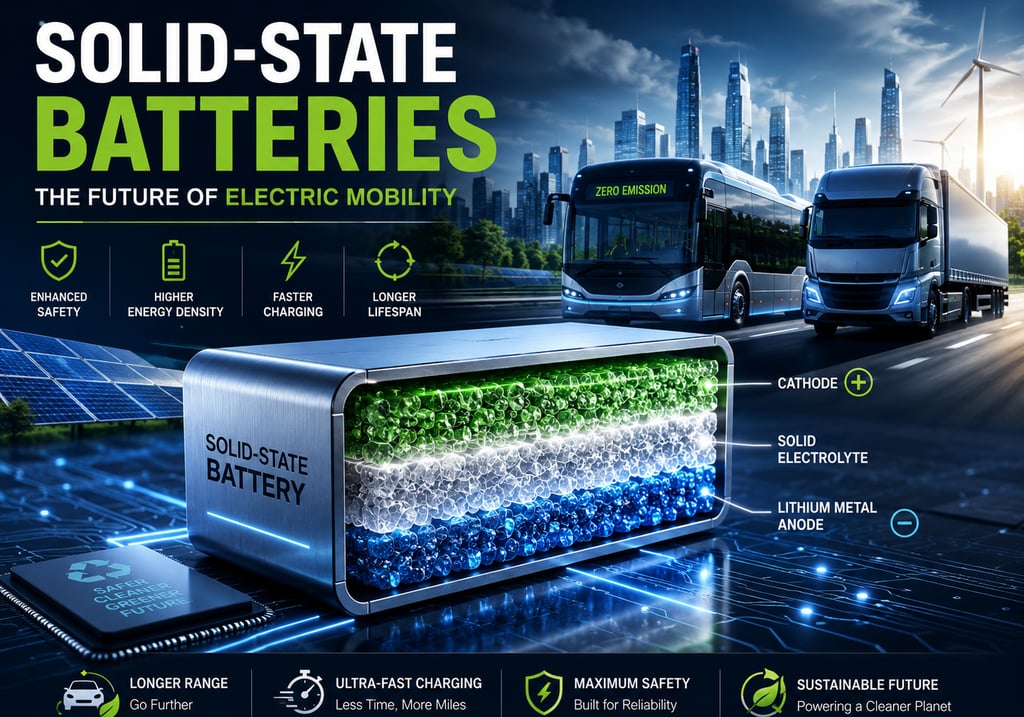
"Battery technology has become the driving force behind the global electric vehicle revolution. Over the past decade, advancements in lithium-ion batteries have enabled EVs to achieve: Longer driving ranges, Faster charging speeds, Improved reliability and Lower operating costs, However, despite significant progress, conventional lithium-ion batteries still face challenges related to: Safety, Charging speed, Energy density, Thermal management and Material costs. This has led researchers and manufacturers worldwide to pursue what many consider the next major breakthrough in battery technology: "Solid-State Batteries" Often described as the "holy grail" of battery innovation, solid-state batteries have the potential to fundamentally transform electric mobility by offering: Higher energy density, Faster charging, Improved safety, Longer lifespan and Better performance in extreme conditions. But how close are we to seeing solid-state batteries in commercial EVs? Let's explore. What Is a Solid-State Battery? A conventional lithium-ion battery contains: Anode, Cathode and Liquid electrolyte. The electrolyte allows lithium ions to move between the electrodes during charging and discharging. In contrast: Solid-state batteries replace the liquid electrolyte with a solid electrolyte. The simplified structure becomes: Anode, Cathode, Solid Electrolyte. This seemingly simple change has the potential to solve several limitations associated with traditional battery technology. "Why Liquid Electrolytes Create Challenges" Current lithium-ion batteries use flammable liquid electrolytes. Under abnormal conditions such as: Physical damage, Internal short circuits, Overheating and Manufacturing defects, the liquid electrolyte can contribute to: Thermal runaway, Battery fires and Safety risks. This is one reason battery thermal management systems remain critical in modern EVs. Solid-state batteries aim to significantly reduce these risks. 1- Improved Safety:- One of the biggest advantages of solid-state batteries is: Enhanced Safety, Because solid electrolytes are generally: Non-flammable, More thermally stable and Less prone to leakage, the risk of catastrophic battery failure can be substantially reduced. This may significantly improve protection against: Thermal runaway, Fire propagation and Internal short circuits, For commercial fleets operating on large battery systems, enhanced safety is particularly valuable. 2- Higher Energy Density:- Perhaps the most exciting advantage is: Higher Energy Density, Energy density determines how much energy can be stored within a given battery size and weight. Higher energy density means: Longer driving range, Smaller battery packs Reduced vehicle weight and Improved efficiency. Future solid-state batteries may potentially offer: 30 to 80% higher energy density. Compared to many current lithium-ion batteries. This could allow EVs to travel significantly farther on a single charge. 3- Faster Charging Potential:- Charging speed remains one of the major concerns for EV adoption. Many researchers believe solid-state batteries could support: Higher charging currents, Improved thermal stability and Reduced charging limitations. Future solid-state systems may potentially achieve: Shorter charging times, Improved charging efficiency and Better battery longevity. Although commercial deployment is still developing, the potential benefits are substantial. 4- Longer Battery Life:- Battery degradation remains a key consideration for fleet operators. Over time, conventional batteries gradually lose capacity due to: Charge-discharge cycles, Temperature stress and Chemical aging. Solid-state batteries may offer: Improved cycle life, Reduced degradation and Better long-term stability. This could help reduce lifecycle costs for commercial fleet applications. "Why Commercial Fleets Are Interested; Commercial EV operators focus heavily on: Reliability, Safety, Operating costs and Battery lifespan, Solid-state batteries could potentially improve: Fleet Economics, Through: Longer range, Reduced downtime, Faster charging, Lower maintenance requirements and Improved safety margins. For electric buses, logistics fleets, and heavy-duty transport applications, these benefits could be significant. "The Lithium Metal Advantage" One reason solid-state batteries attract so much attention is their ability to utilize: Lithium Metal Anodes, Lithium metal can store significantly more energy than conventional graphite anodes. This contributes directly to: Higher energy density and Improved range potential. However, safely using lithium metal has historically been difficult. Solid-state technology may provide a practical pathway to unlock this capability. "Challenges Still Facing Solid-State Batteries" Despite the excitement, several technical challenges remain. 1- Manufacturing Complexity: Producing solid-state batteries at large scale remains difficult. Challenges include: Material processing, Precision manufacturing, Interface stability and Production consistency. Mass production technologies are still evolving. 2- High Production Costs: Current solid-state battery prototypes are generally more expensive than conventional lithium-ion batteries. Manufacturers must reduce: Material costs, Manufacturing costs and Production complexity, before large-scale commercialization becomes economically viable. 3- Durability Challenges: Although promising, some solid electrolyte materials still face challenges involving: Cracking, Mechanical stress and Long-term reliability. Researchers continue working to improve durability. "Which Companies Are Developing Solid-State Batteries? Several major automotive and battery manufacturers are investing heavily in solid-state technology. Notable developers include: Toyota, Nissan, BMW, Volkswagen, Samsung SDI and CATL. Billions of dollars are being invested globally to accelerate development and commercialization. Will Solid-State Batteries Replace LFP Batteries? Not necessarily. Many experts believe future battery markets will include multiple technologies serving different applications. LFP Batteries, Continue to offer: Excellent safety, Low cost, Long lifespan and Strong suitability for commercial fleets. "Solid-State Batteries" May become more attractive for: Long-range EVs, Premium vehicles, Aviation applications and High-performance transportation. Different battery chemistries will likely coexist rather than completely replace one another. What Could This Mean for Commercial EV Fleets? If solid-state batteries achieve large-scale commercialization, commercial fleets could potentially benefit from: Longer Operating Range, Allowing: Fewer charging stops and Greater route flexibility. "Faster Charging" Reducing: Downtime and Depot charging requirements. Improved Safety, Enhancing: Fleet reliability and Operational confidence. Better Total Cost of Ownership" Through: Extended battery life, Improved energy efficiency and Reduced operational interruptions. When Will Solid-State Batteries Become Common? This remains one of the biggest questions. Many manufacturers are targeting: Late 2020s to Early 2030s for broader commercialization. Initial deployment will likely occur in: Premium EVs, Specialized vehicles and High-performance applications. before eventually expanding into mass-market and commercial fleet segments. The Future Beyond Lithium-Ion: Solid-state batteries represent more than just another battery improvement. They could redefine: Vehicle design, Charging infrastructure, Fleet operations and Energy storage systems. By addressing some of the most significant limitations of current batteries, solid-state technology may help accelerate the next phase of global electrification. "Final Thoughts: Solid-state batteries are widely regarded as one of the most promising developments in the future of electric mobility. Their potential advantages include: Higher energy density, Faster charging, Improved safety, Longer lifespan and Better overall performance. While technical and manufacturing challenges still remain, industry investment continues to grow rapidly. Whether for passenger vehicles, commercial fleets, renewable energy storage, or future transportation systems, solid-state batteries could become one of the defining technologies of the next generation of electrification. The future of electric mobility may not simply involve better batteries, it may involve an entirely new battery architecture. Thank you
Connect
Get in touch for sustainable transport solutions.
Head of Operations (Australia): Mr. Tauqeer Banoori
© 2025. All rights reserved.
Contact: +61 415 605 202